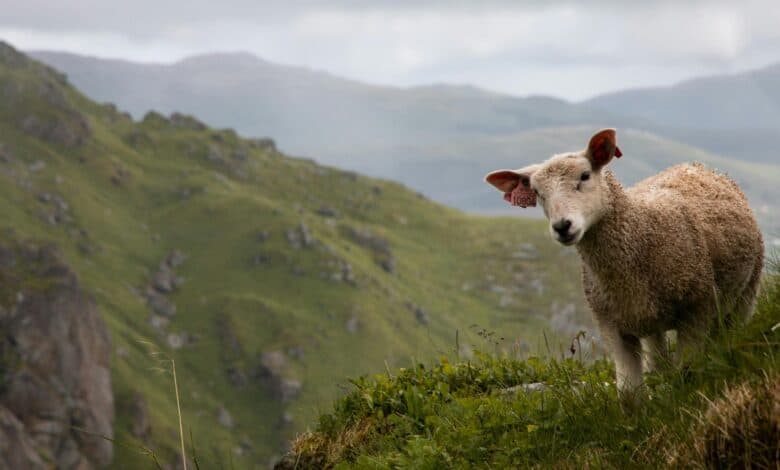

In the rugged, mountainous Drakensberg grasslands of South Africa’s Eastern Cape, sheep farming is more than an economic activity. It is food security, cultural practice and a fragile financial lifeline for rural households.
Here, steep slopes, cold winters, frost and seasonal droughts already shape the rhythms of everyday life.
ALSO READ | Europe heatwave ‘brutal reminder’ of climate change
But rising temperatures, prolonged droughts, erratic rainfall and extreme weather events are now reshaping the system itself, altering how livestock farming survives in some of the country’s most climate-sensitive landscapes.
Families in communal villages typically keep small flocks of between 10 and 50 sheep, unlike commercial farms with large herds and fenced grazing systems.
The animals are kept in simple overnight kraals near homesteads and released during the day onto shared rangelands.
These communal grazing systems are rooted in long-standing traditions and social arrangements.
Farmers rely on natural pastures, seasonal rainfall and indigenous knowledge to manage their flocks.
ALSO READ | Collaborative efforts to address climate change imperative says Ntuli
But that balance is under increasing strain.
The consequences of a changing climate are already visible: reduced pasture availability, rising livestock disease, and increasing lamb mortality.
Climate pressure is already shaping farming decisions
The Conversation’s researchers working on climate change, livestock systems and rural livelihoods in South Africa have focused on three villages, Mabua, Tothaneng and Madlangala in the Drakensberg grasslands.
The aim was to understand how smallholder sheep farmers experience climate risks and how they respond.
A group of 89 farmers were a part of focus group discussions and community meetings where they shared how they were adapting.
ALSO READ | Climate change leaves communities in SA vulnerable to flooding
The Conversation said that it became clear that climate change was no longer a distant threat but rather that it is already shaping everyday farming decisions.
Drought and heatwaves were identified as the most severe risks, but frost, floods, veld fires and storms also featured repeatedly.
One farmer explained to The Conversation that during drought, sheep lost weight and died due to a lack of grass.
Because sheep in these systems depend heavily on natural grazing, the impacts are immediate, and a domino effect occurs with entire livelihoods.
Drought, disease and weakened flocks
Drought and harsh winters reduce available grazing, directly affecting animal growth, reproduction and survival.
“When the drought comes, the grass disappears and the sheep become very weak. Some die before the rains return,” said a farmer from Tothaneng, in the Matatiele area.
ALSO READ | UK spearheads polar climate change research as US draws back
Changing weather patterns are also linked to rising livestock diseases. Parasites and foot rot were reported more frequently after heavy rains and sudden temperature shifts.
“We now see more sickness after heavy rains and sudden weather changes. The sheep struggle more than before,” a farmer in Mabua, south-west of Mthatha told The Conversation.
In many cases, sheep are kept in open kraals without proper shelter, leaving lambs particularly vulnerable.
“During cold winters and storms, the lambs suffer the most because we do not have proper shelters,” said a farmer from Madlangala.
Communities are adapting — but unevenly
Despite growing pressures, farmers are not passive. They are actively adapting using a mix of traditional and practical strategies.
These include rotational grazing, veld resting, supplementary feeding during dry periods, and crossbreeding hardy indigenous sheep.
ALSO READ | Climate change also comes with opportunities: Premier Ntuli
Some communities are also rehabilitating eroded land, while others rely on indigenous weather forecasting.
One farmer described how environmental cues guide decisions.
We depend on experience and signs from nature to know when the weather will change. For example, when cattle become restless, birds fly low, winds shift direction, and clouds build up in the west.
Social networks also play a critical role. Villages with stronger farmer associations were better able to coordinate grazing, share knowledge and respond to droughts.
Madlangala showed stronger organisation and support systems, while Tothaneng emerged as more vulnerable due to weaker institutional support and limited access to extension services.
What needs to happen next
The findings show that climate change is already threatening the livelihoods and food security of vulnerable rural households. Farmers are adapting, but their efforts are uneven and often under-resourced.
ALSO READ | KZN foot and mouth infections on the rise
To strengthen resilience, support is needed from government departments, extension services, researchers and development organisations.
Key priorities include early warning systems, veterinary services, climate-smart grazing support, and investment in basic livestock infrastructure such as shelters and water systems.
Reliable disease management services and stronger community-based adaptation programmes are also critical.
Just as important is strengthening farmer organisations and creating incentives for young people to remain in agriculture.
Without this, the long-term sustainability of communal livestock systems remains uncertain.