
New research reveals deadly bacteria lurking in hippo mouths
Victims who survive a hippo attack could face severe complications if they are not treated quickly with the correct medication.
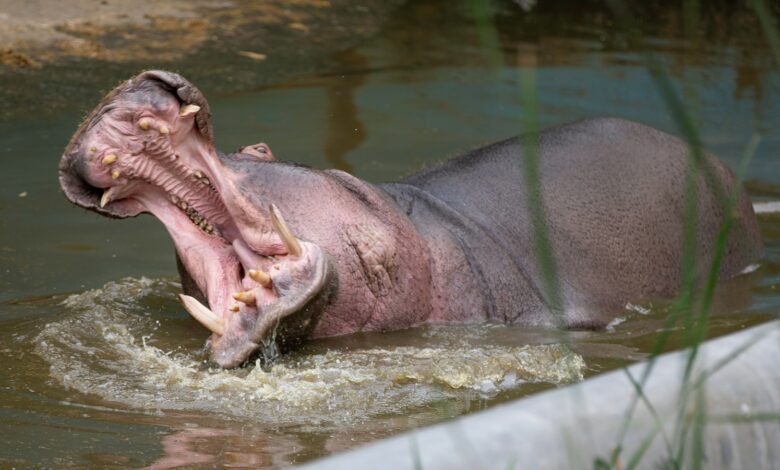

Surviving a hippopotamus attack may not be the end of the danger, with new South African research revealing that deadly, antibiotic-resistant bacteria lurking in the animals’ mouths could prove just as life-threatening as their crushing bite.
Scientists from the University of Pretoria have discovered, for the first time, that hippos carry dozens of bacterial species in their mouths, many of which can cause serious infections in humans and show resistance to commonly prescribed antibiotics.
ALSO READ | Indian billionaire’s son offers home for Escobar’s hippos
The findings suggest that even victims who survive a hippo attack could face severe complications if they are not treated quickly with the correct medication.
Known for their immense strength and unpredictable behaviour, hippopotami kill an estimated 500 people across Africa every year, more than twice as many as lions.
While their powerful jaws and razor-sharp canine teeth have long been recognised as the main threat, researchers say the hidden danger begins after the bite.
Lead researcher Professor Anita Michel, from the University of Pretoria’s Faculty of Veterinary Science, said the study was prompted by the severity of injuries suffered by hippo attack victims.
“We knew the injuries were extraordinary, especially with the exceptional biting force hippos possess, but we didn’t fully understand the link between the microbes and the severe complications from wound infections that clinicians have to deal with,” she said.
Michel’s team, including veterinary bacteriologist Dr Annelize Jonker and ecologist Francois Roux from the Mpumalanga Tourism and Parks Agency, examined the mouths of 34 healthy hippopotami during routine wildlife operations in Mpumalanga.
ALSO READ | Watch: Wildlife capturer’s son survives hippo boat flip near Hoedspruit
The researchers identified 41 different bacterial species, many commonly found in aquatic environments and capable of causing opportunistic infections in people.
“This was the first time that anyone has systematically studied the bacterial flora of hippos’ mouths,” Michel said.
And what we found was concerning, not just the types of bacteria, but their resistance to some of the most commonly used antibiotics.
Testing revealed moderate to high resistance to antibiotics such as amoxicillin/clavulanate and early-generation cephalosporins, medicines routinely prescribed for bite wounds from animals such as dogs and cats.
Michel warned that relying on these standard treatments for hippo bite victims could delay effective care.
“Using these standard antibiotics for a hippo bite may delay effective treatment and allow infections to take hold,” she said.
The study found that antibiotics from the tetracycline, aminoglycoside and quinolone families were significantly more effective against the bacteria.
Researchers also recommend that doctors take wound cultures as early as possible so treatment can be tailored to the specific bacteria present.
ALSO READ | WATCH | Snared hippo tragedy claims 2 lives in Mfolozi River
“It is critically important that wound infections, whether in animals or humans, are treated early with an effective antibiotic regimen aligned with the expected causative infectious agents,” Michel said.
The findings also highlight the growing challenge of antibiotic resistance beyond hospitals and healthcare facilities.
“Our goal is to take a One Health approach with healthcare providers in regions where humans and wildlife intersect to ensure that they are not caught off guard,” Michel said.
When you’re dealing with a hippo bite, minutes matter, and so does the right antibiotic.
The research underscores the risks posed by one of Africa’s deadliest mammals.
A hippopotamus can generate a bite force of around 8 100 Newtons, equivalent to the weight of a small car, while opening its mouth to about 1.5 metres wide.
With 40cm incisors and canine teeth measuring more than 50cm, the study suggests that escaping a hippo’s jaws may only be the first battle. The microscopic threat left behind could be just as deadly if not treated correctly.